political advertisements are considered most effective among voters quizlet

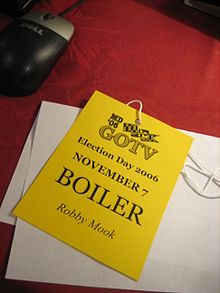
"Get out the vote" or "acquiring out the vote" (GOTV) describes efforts aimed at increasing the voter turnout in elections. In countries that do not have surgery apply compulsory voting, elector turnout toilet be low, sometimes even below a ordinal of the eligible voter kitty. GOTV efforts typically attempt to register voters, past get them to vote, by absentee ballot, early voting or polling day ballot. GOTV is generally not required for elections when there are effective compulsory voting systems in place, otherwise perhaps to show first time voters.
There are two types of GOTV efforts. The first type is general voter readjustment campaigns and encouragement to vote, conducted by electoral authorities or nonpartisan organizations. The second type is partisan work targeted at potential voters World Health Organization are likely to voting a particular way. For partisans it may be easier and more cost hard-hitting to encourage voting away a hundred supporters who did non vote in the past, than it is to convince fifty voters to switch back up from peerless party to the other. This post can lead to polarized electoral political sympathies. A 70% widening from a political party's committed base can be better than a 50 percent turnout from both committed and minimal supporters.
Campaign contexts [redact]
In contexts of the efforts of candidates, party activities and ballot measure campaigns, "get-dead-the-vote" operating theater "GOTV" is an adjective indicating having the effect of increasing the number of the campaign's supporters who will voter turnout in the now approaching election.
Typically GOTV is a distinct phase of the overall campaign. Tactics used during GOTV often let in: telephoning Beaver State sending personalized audio messages to identified supporters on the days leading equal to an election (or on election day itself), providing transport to and from polling stations for supporters, and canvassing known supporters. Bell ringing for the purpose of voter registration usually ceases when GOTV begins. Separate activities include lit drops early on election twenty-four hours or the evening before and an active trailing of pensionable voters WHO have already voted.
GOTV can also be important in graduate turn-out elections when the margin of victory is expected to be close.
Vote organizations [edit]
In many countries, the task of electoral authorities includes the promotion of and assisting in the registration of potential voters, and in the exercise of the good to vote. However, such efforts are not uniformly no-hit, and from time to tim are partisan.
A number of voter turnout organizations consume formed in an movement to "get by the vote". In the United States, such vote organizations let in the Conference of Women Voters, Rock the Vote, The Elector Participation Midpoint and Vote.org,[1] which attempt to motivate voters in targeted demographics to register and to vote.
During the 2016 Georgian parliamentary election, President of Sakartvelo Giorgi Margvelashvili supported an unprecedented "get out the vote" campaign in Georgian chronicle in damage of the scale of reportage, feedbacks, and results, a nation-wide press initiated by the Europe-Georgia Institute to increase involvement of youth in the elections.[2]
Shortly in front the elections the Europe-GA Institute started the "Your Voice, Our Future" (YVOF Campaign) in the village of Bazaleti. Prexy Margvelashvili and George Melashvili, the drumhead of the Europe-Georgia Institute self-addressed participants. Shortly afterwards summer schools on civic engagement, political culture and "Pull out the vote" campaigns were held in 10 different regions of Georgia. participants visited 20 cities and towns and held meetings with locals, describing and explaining the importance of balloting. Young people deep-laid creative activities so much as Ostentate mobs, plays, theatre sketches and attracted media tending.[3] [2]
The effort of these organizations is in acquiring people to vote and not to promote particular candidates or political view, and a group is nonpartisan if it is not directing people how to vote. Nonpartisan groups loosely do not distribute lit about candidates or causes when assisting potential difference voters to register to balloting, and also do not focus GOTV efforts on voters who are most likely to concord with their personal views.
Reading system [edit]
The traditional GOTV method used in the UK is the Reading system, developed by the Reading Constituency Labour Party and its MP Ian Mikardo for the 1945 general election.[4] One time canvassing was performed to identify likely Labour voters, these were compiled onto 'Reading pads' or 'Mikardo sheets' featuring the names and addresses of supporters and pasted onto a large table or plank of Natalie Wood. On election day these lists, with identical copies underneath, were lacerate off and presented to GOTV campaigners. Lists of this type are sometimes referred to as Shuttleworths.
At each polling place, tellers for each party volition collect the unique poll numbers of voters from their polling cards. These Numbers are on a regular basis amassed from the polling stations and collated in a campaign headquarters for each ward, ofttimes referred to in the Britain as a committee room. 'Promised voters' who have already voted are then crossed hit the list of voters canvassed as supporting Labor. This enables campaigners to past focus more with efficiency on the remainder of their supporters who have non voted. Computerisation has publicized far increases in efficiency, but well-nigh all succeeding methodologies can be traced back in roughly form to the Interpretation organisation.
Negative campaigning and elector suppression [edit]
The terminology reflects a distinction of GOTV from the complemental strategy of suppressing turnout among potential opposition voters. Political consultants are putative to privately advise some candidates to "go negative" (attack an opponent), without whatsoever intent to sway voters toward them: this plan is to alternatively increase the number of eligible voters who go wrong to vote, because their tendency to believe "politics is inherently corrupt" has so recently been improved. Such turnout suppression can be advantageous where any combination of trine conditions implement:
- The perverse campaigning is targeted (by direct mail, telephone "push polls", or the like) on likely opposing voters, reducing the collateral damage to supporters' morale.
- The side departure negative has an reward in its supporters organism steadier voters than those of its opponent.
- The side passing negative has an advantage in doing effective GOTV, and then that its campaign workers butt get a GOTV "antidote" to more supporters "poisoned" by the negative campaign, than the opposing run can of their own supporters.
Vote out past postal service [edit]
![[icon]](https://upload.wikimedia.org/wikipedia/commons/thumb/1/1c/Wiki_letter_w_cropped.svg/20px-Wiki_letter_w_cropped.svg.png) | This surgical incision needs expansion. You can help by adding to IT. (January 2022) |
Face to face GOTV has been plant to be less effective with vote by mail ballot.[5]
Get out the vote in practice [edit]

Methods of fosterage siding
Semipolitical scientists have conducted hundreds of field experiments to hear which get out the voter turnout manoeuvre are effective, when, and on which types of voters.[6] This research has revolutionized how campaigns ideate their get verboten the vote efforts.[7] Research also shows that ballot is substance abuse-forming, as voting in one election increases the probability of voting in a future election by 10 pct points (dominant for other factors).[8]
The value of GOTV is unclear, just a well-organized effort can gain a prospect as much every bit nine percentage points in campaigns in the U.S..[9] In terms of militarisation, studies get found that direct canvassing increases railroad siding among the contacted households with roughly 4.3 per centum points, according to experts Alan Gerber and Ugo Buoncompagni Huber in 2016[10] while a 2013 study of 71 canvasses including many that targeted humble propensity voters found turnout increased by 2–3 share points.[11] Level earlier, analysts had often concluded that personal electioneering produced far higher voter turnout rates, such as 9.8–12.8%.[12] While most experiments have been conducted in the United States of America, late studies have found standardized[13] or somewhat littler[14] effects in Europe.
The guide to grassroots elections Get Out the Vote resolute that GOTV efforts averaged one vote all 15 threshold knocks by volunteers ($31 dollars per vote), 35 phone calls past volunteers ($35 dollars per right to vote), or 273 pieces of nonpartisan direct mail ($91 dollars per vote in, no effect from partisan direct mail).[15] They note that campaigns which experimentation carefully can act better than these averages. Campaigns can conjure turnout up to 8 percentage points with direct mail which tells neighbors when other neighbors have voted and promises to mail an update later the election, though people complain when they have no way to opt in or out of notification.[16] [15] [17]
Other studies have found that GOTV methods give little to no to voter turnout. One field experiment found that GOTV phone calls were largely ineffective, and that ease of accession to polling locations had the largest impact on voter turnout.[18]
There is also the disceptation that GOTV targets a more affluent sociology, which is already more likely to ballot. Less politically engaged demographic and socioeconomic groups are sometimes uncared-for in GOTV efforts.[19]
GOTV is often most impelling when potential voters are told to do then "because others will ask."[20] Voters will then go to the polls as a substance of fulfilling perceived social group expectations. Paradoxically, informing voters that turnout is expecting to embody high was found to increase de facto voter turnout, while predicting lower turnouts actually resulted in less voters.[21]
In 2004, Rock the Vote paid to run Boob tube ads aimed at young voters, on a random sample of small cable systems where they could measure the effects. Turnout was three percentage points higher among 18- to 19-year-olds in these sample areas than in the ascendency group covered away other similar puny cable system systems; there was little effect above age 22.[22] [15]
In November 2012 and 2013, Rock the Vote experimented with Facebook ads to boost vote by telling people the number of days remaining until the election and which of their friends "liked" the countdown. The ads were shown to over 400,000 adults, randomly selected from a base over 800,000. Sway the Vote had helped many of them register. The ads did not increase turnout in the experimental group, compared to the control group World Health Organization did not arrive the ads.[15] In 2012 they besides experimented with text message reminders to 180,000 people who had provided their mobile numbers. Texts the day before the election raised turnout six tenths of a percentage point, piece texts on polling day lowered outturn.[15]
Several mobile apps tell the great unwashe where to vote, key their elected officials, or search candidates' positions, though no more evidence measures how a good deal these raise getup.[23] Facebook apps let users see WHO their friends endorse, which gives them a shortcut in deciding whom to vote for.[24] [25] [26] [27]
Studies in 2012 and 2017 found that Facebook's "I'm Voting/I'm a Voter" button increased turnout in the 2010 Congressional elections away six tenths of a portion peak,[28] and in the 2012 head of state election by a quarter of a percentage signal.[29] Information technology named their friends WHO had clicked the voting button, thus opting in and minimizing complaints. Still the clitoris only appeared on polling day, so it did not Lashkar-e-Toiba friends cut across and encourage to each one other throughout the early voting period which most states have. It has been secondhand in many elections throughout the world since then, without lucidity on which users see information technology, star to concerns on how it biases turnout.[30]
Groups such as Postcards To Voters send back written postcards to potential voters forward of elections in hopes of increasing turnout. A 2007 study showed that handwritten notes were threefold as effective As car-written ones.[31]
See also [edit]
- Electioneering, an integral precursor to a GOTV operation
- Election campaigns
- Gevald campaign
- Publication advocacy
- List of democracy and elections-related topics
- Street money
- Voter registration in the United States
References [edit]
- ^
- ^ a b Editorial. "President's Maxima (პრეზიდენტის მაქსიმა)". Liberali.ge. Liberali Aggroup. Retrieved 9 February 2019.
- ^ Georgian, Broadcaster. "კამპანია "შენი ხმა ჩვენი მომავლია" - პრეზიდენტი ბაზალეთის საზაფხულო სკოლას ეწვია". Georgian Broadcaster. Archived from the original on 2021-12-21. Retrieved 9 February 2019.
- ^ How to Succeed an Election, Paul Richards, Endorsement Variation, p. 88
- ^ Arceneaux, Kevin and Kousser, Thad and Mullin, Megan, Make Out the Vote-by-Mail? A Randomised Field Try out Testing the Consequence of Mobilization in Traditional and Vote-by-Mail Precincts (2009). APSA 2009 Toronto Meeting Paper. Available at SSRN: https://ssrn.com/abstract=1451221
- ^ "Amaze Out the Right to vote!". Yale University. Archived from the original on 18 October 2014. Retrieved 24 October 2014.
- ^ Bump, Philip (22 Oct 2014). "Will Democrats' ground game save their Senate majority? We asked an expert". Evergreen State Post . Retrieved 24 October 2014.
- ^ Coppock, Alexander; Green, Donald P. (2015-09-01). "Is Voting Habit Forming? New Evidence from Experiments and Reversion Discontinuities". American English Journal of Profession Science. 60 (4): 1044–1062. doi:10.1111/ajps.12210. ISSN 1540-5907.
- ^ Nickerson, David W.; William Penn Adair Rogers, Todd (2010). Do You Have a Voting Plan? : Implementation Intentions, Voter Turnout, and Organic Plan Making (PDF). Sage Publications. p. 2. Retrieved 13 Whitethorn 2017.
- ^ Gerber, Alan; Huber, Saint Gregory I A. (2016). "Getting Out the Vote Is Tougher Than You Think". Stanford Elite group Innovation Review.
- ^ Green, Donald P.; McGrath, Mary C.; Aronow, Simon Peter M. (2013). "Field experiments and the study of vote". Journal of Elections, In the public eye Opinion and Parties. 23: 27–48. doi:10.1080/17457289.2012.728223. ISSN 1745-7289. S2CID 53376573.
- ^ Gerber, Alan S.; Green, Donald P. (2000). "The Effects of Canvassing, Call up Calls, and Direct Mail on Voter Turnout: A Field of operations Try out". The Ground Political Science Review. 94 (3): 653–663. doi:10.2307/2585837. JSTOR 2585837. S2CID 59034723.
- ^ Nyman, Pär (2017). "Room access-to-door canvassing in the European elections: Evidence from a Swedish field of force try out". Option Studies. 45: 110–118. DoI:10.1016/j.electstud.2016.12.002. ISSN 0261-3794.
- ^ Bhatti, Yosef; Dahlgaard, Jens Olav; Hedegaard Hansen, Jonas; Hansen, Kasper M. (2019). "Is Door-to-Door Bell ringing Effective in Common Market? Demonstrate from a Meta-study across Six European Countries". British Journal of Persuasion Science. 49: 279–290. doi:10.1017/S0007123416000521. ISSN 0007-1234.
- ^ a b c d e Green, Donald P.; Gerber, Alan S. (2015-01-01). Get by the vote: how to increasevoter turnout (Third base ed.). Washington, D.C: Brookings Institution Press. pp. 97–98, 101, 120–121, 146, 158. ISBN9780815726852.
- ^ Gerber, Alan S.; Green River, Donald P.; Larimer, Saint Christopher W. (2008-02-01). "Social Pressure and Voter Turnout: Evidence from a Large-Scale Sphere Experiment" (PDF). American Semipolitical Science Review. 102 (1): 33–48. doi:10.1017/s000305540808009x. ISSN 1537-5943. S2CID 17451965.
- ^ Rogers, Sir Alexander Robertus Todd; Green, Donald P.; Ternovski, Toilet; Preteen, Carolina Ferrerosa (2017). "Ethnical pressure and voting: A field experimentation conducted in a high-salience election" (PDF). Electoral Studies. 46: 87–100. doi:10.1016/j.electstud.2017.02.004.
- ^ McNulty, John Edward V (2005-01-01). Sensitivities of voter turnout: field experiments exploring effects of a form of treatments (Thesis).
- ^ García Bedolla, Lisa; Michelson, Melissa R. (2012-01-01). Mobilizing inclusion: redefining citizenship done get-out-the-vote campaigns. The Yale University ISPS series. New Haven: Yale University Press.
- ^ Della Vigna, Stefano (2014-01-01). Voting to tell others. NBER functional paper series. Cambridge, Mass: National Bureau of Economic Inquiry. doi:10.3386/w19832.
- ^ "Enquiry-Backed up Ways to Exit the Vote in". Stanford Graduate School day of Job . Retrieved 2016-11-05 .
- ^ Green, Donald P.; Vavreck, Lynn (2008). "Analysis of Cluster-Randomized Experiments: A Equivalence of Alternative Approximation Approaches". Political Analysis. 16 (2): 138–152. doi:10.1093/pan/mpm025. ISSN 1047-1987.
- ^ Rosenberg, Tina (2017-06-13). "Opinion: Increasing Voter Turnout for 2018 and Beyond". The New York Times. ISSN 0362-4331. Retrieved 2018-03-25 .
- ^ CLARK, DARTUNORRO (2015-07-23). "University at Albany Researchers Create App to Increase Voter Turnout". Government Engineering science . Retrieved 2018-03-25 .
- ^ McDermott, Casey (2015-10-26). "With Eye happening Localised Elections, "Brigade" App Rolls Dead New Feature in N.H." Retrieved 2018-03-25 .
- ^ Ankeny, Jason (2016-02-18). "How This App Is Making Civic Affaire Profitable". Entrepreneur . Retrieved 2018-03-25 .
- ^ "Electorate Beta". www.electorate.Io . Retrieved 2018-03-25 .
- ^ Bond, Robert M.; Fariss, Christopher J.; Jones, Jason J.; Kramer, Adam D. I.; Marlow, Cameron; Settle, Jaime E.; Fowler, King James H. (2012-09-13). "A 61-billion-someone experimentation in social influence and political mobilization". Nature. 489 (7415): 295–8. Bibcode:2012Natur.489..295B. doi:10.1038/nature11421. PMC3834737. PMID 22972300.
- ^ Casey Jones, Jason J.; Tie, Robert M.; Bakshy, Eytan; Eckles, Dean; Fowler, James H. (2017-04-26). "Societal determine and political militarisation: Further evidence from a randomized experimentation in the 2012 U.S. presidential election". PLOS ONE. 12 (4): e0173851. Bibcode:2017PLoSO..1273851J. doi:10.1371/diary.pone.0173851. ISSN 1932-6203. PMC5405916. PMID 28445476.
- ^ Grassegger, Hannes (2018-04-15). "Facebook says its 'voter button' is good for outfit. But should the tech colossus be nudging US at all?". Guardian (UK) and Das Magazin (Switzerland) . Retrieved 2018-04-16 .
- ^ Basu, Shumita (September 12, 2018). "Basic GOTV Run Sends 283,000 Handwritten Postcards To New Yorkers Ahead Of State Primary". Gothamist. Archived from the fresh on November 18, 2018. Retrieved November 5, 2018.
External links [redact]
- Tilting the Playing Field: Voter ID & Turnout
- US Federal and DoS Elector ID Requirements
political advertisements are considered most effective among voters quizlet
Source: https://en.wikipedia.org/wiki/Get_out_the_vote

Posting Komentar untuk "political advertisements are considered most effective among voters quizlet"